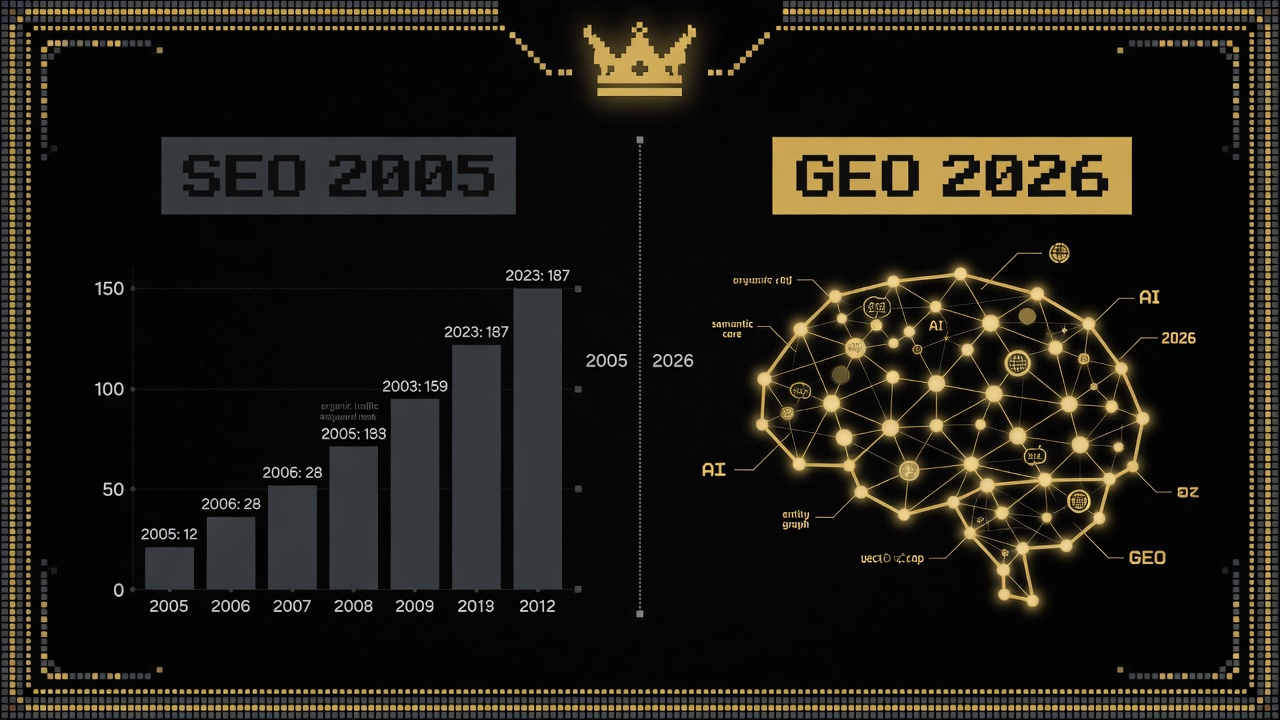
In 2005, most businesses didn't have an SEO strategy. They had a website. They figured that was enough.
The ones who invested early in keyword research, backlinks, and on-page optimization built advantages that took competitors a decade to close. The ones who waited until SEO was "mainstream" were permanently behind.
We're at the same inflection point right now. It's just a different channel.
Generative Engine Optimization (GEO) — the practice of making your brand discoverable inside AI-generated answers — is where SEO was in 2005. The window for first-mover advantage is open. It won't be for long.
GEO vs SEO: a different game entirely
The confusion most people have is thinking GEO is just SEO adapted for AI. It's not. The rules are fundamentally different.
| Traditional SEO | GEO (Generative Engine Optimization) |
|---|---|
| Rank pages for keywords | Get named in AI-generated answers |
| Domain authority + backlinks | Named mentions across diverse public sources |
| Keyword density matters | Semantic context + category association |
| Measured in rankings and clicks | Measured in AI citation rate and recognition score |
| You can see exactly where you rank | Most brands have no idea if they're visible |
That last row is the critical one. With SEO, you can Google yourself. With AI search, most brands are flying completely blind.
88% of AI citations don't appear in the Google top 10 for the same query. Google ranking and AI visibility are nearly independent. You can dominate SEO and be invisible to AI. You can rank poorly on Google and be consistently recommended by ChatGPT. They're separate games.
What GEO actually measures
GEO isn't a single metric. It's a composite of signals across four dimensions that determine whether an AI will recommend your product when someone asks a relevant question.
1. Direct Recognition
Does AI know your product by name? Can it describe what it does, who it's for, and what problem it solves — without hallucinating? Recognition is the baseline. Without it, nothing else matters.
2. Category Ranking
When someone asks "what are the best tools for X," does your product appear in the top 10? Category ranking is what drives unsolicited recommendations — the most valuable kind, because the user never mentioned you by name.
3. Co-Recommendation Graph
When AI mentions your product, what does it mention alongside it? Products that are consistently grouped with category leaders inherit credibility through proximity. Products that appear alone — or not at all — miss this amplification effect.
4. Web Authority Signal
Independent web presence: citations, mentions in third-party content, named appearances in reviews and roundups. This is the bridge between traditional SEO and AI visibility — the signals that feed into both systems.
Why early movers win
AI models are retrained periodically. The data that gets included shapes what the model "knows" about your category. Products with strong public signal at training time get baked into the model's understanding of what belongs in that space.
Products that show up after training are playing catch-up — not just against competitors, but against the model's prior assumptions about who the players in the category are.
This is why companies are scrambling to get GEO services right now. Marketing agencies announced GEO service expansions this month. SEO tools are adding GEO tracking. The category is moving fast.
Daily AI search usage in the US jumped from 14% to nearly 30% in a single year. That trajectory means the AI channel will be primary for most categories within 18 months. The question isn't whether to invest in GEO — it's whether you'll be the first in your space or the one catching up.
How to measure your GEO standing right now
The first problem most brands face is measurement. You can't optimize what you can't see.
pickedby.ai runs your product through a systematic probe across AI engines — asking recognition questions, category ranking questions, co-recommendation analysis — and returns a score from 0 to 100 with a breakdown across all four GEO dimensions.
It takes about 10 seconds. It's free. And it tells you exactly where you stand before you start making changes.
Because unlike SEO, where you might spend months guessing, GEO gives you a baseline you can measure against as you build signal over time.
WHAT'S YOUR GEO SCORE?
See how ChatGPT, Gemini, Claude, Grok, and Perplexity rank your product across recognition, category, co-recommendation, and web authority. Free, no signup.
CHECK MY GEO SCORE — FREE ▶▶The brands building GEO signal today will be the ones AI recommends in 2027. That's not speculation — it's how the training data cycle works.
See how the scoring actually works: How we calculate your AI Visibility Score →