Most GEO advice sounds like this: "create high-quality content," "build authority," "be consistent." It is the same recycled SEO advice with AI sprinkled on top. It is also mostly useless.
We built a Prescription Engine that runs against your product across five AI engines — GPT, Gemini, Claude, Grok, and Perplexity — and ranks your biggest visibility gaps by impact. After running this engine on our own product and watching what actually moved the score, here is what we found.
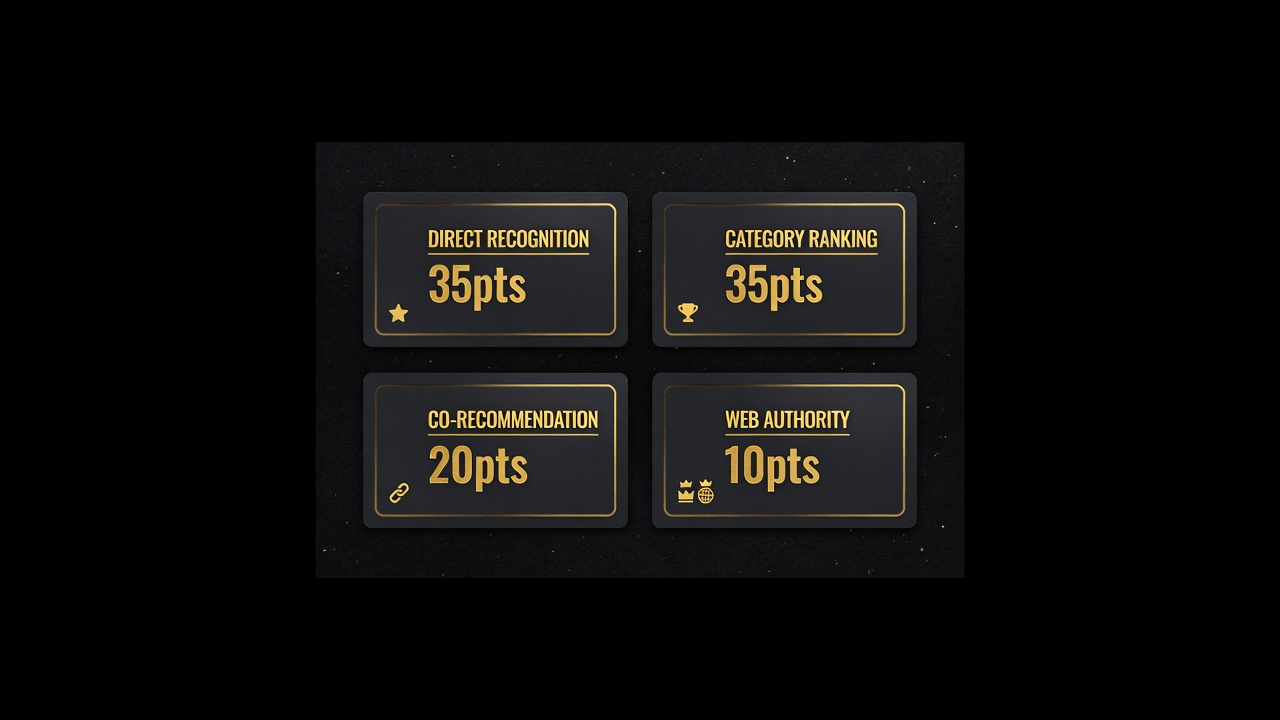
How our scoring works: Your AI Visibility Score is 0–100 across four dimensions: Direct Recognition (35 pts), Category Ranking (35 pts), Co-Recommendation (20 pts), and Web Authority (10 pts). The five items below map directly to the dimensions where real movement happens.
The 5 things that actually work
AI engines answer category queries ("best project management tool for freelancers") by pulling from their training data. If your product isn't explicitly labeled as belonging to a specific category — in your homepage, your README, your blog posts, your schema — you simply don't appear in those answers.
The fix is surprisingly specific: state your category plainly. Not "we help teams collaborate" — but "we are a project management tool for freelancers." AI isn't inferring. It is pattern-matching.
Your own website says you're great. AI doesn't care. What AI cares about is what other sources say about you. Specifically, sources that AI crawlers index heavily: tech publications, curated directories, Reddit threads with upvotes, and high-authority blogs that link to you in context.
One genuine mention in a trusted publication — "we use [your product] for X" — is worth more for AI discovery than ten blog posts you wrote about yourself. This is the Web Authority dimension: third-party trust signals that AI engines use to decide whether your product is worth recommending.
Think of llms.txt as robots.txt but for AI. It's a plain-text file at your root domain that tells AI crawlers exactly what your product is, who it's for, and what problems it solves — in a format that's trivially easy to ingest.
The vast majority of products we check are missing this entirely. Adding it takes about 10 minutes and gives every AI engine a direct, unambiguous path to understanding your product. When an AI is deciding whether to mention you by name in a response, this is the clearest possible signal you can give it.
Being mentioned in GPT but invisible in Gemini, Claude, Grok, and Perplexity means your Direct Recognition score (worth 35 points) is near zero. The scoring system doesn't give partial credit for single-engine presence. Recognition across all five engines is what moves that dimension.
The engines have different training data and different crawl patterns. Perplexity prioritizes real-time web search. Gemini weights Google-indexed content. Claude pulls from Anthropic's training set, which leans toward structured documentation. A strategy that only optimizes for one engine is leaving most of the opportunity on the table.
AI engines learn from context. If your product is frequently mentioned alongside well-known alternatives — "if you like Notion, you might also want to check X" — that association gets encoded. You start appearing as a co-recommendation when buyers ask for alternatives or comparisons.
This is the hardest dimension to move quickly (it's worth 20 points), but it's also the most durable. The way to build it: comparison blog posts, "X vs Y" content, listing yourself on comparison directories, and getting genuinely reviewed alongside your competitors. You want to appear in the same sentence as the incumbents — repeatedly, across many sources.
The 2 things that don't move it (much)
The pattern: Everything that works involves getting external sources to talk about you clearly, specifically, and in context. Everything that doesn't work is self-referential. AI engines are trying to figure out what the world thinks of your product — not what you think of your own product.
How to find your specific biggest gap
The five things above are the highest-impact levers we've identified from how our scoring system works. But every product has a different starting point. Your biggest gap might be Category Ranking. Ours was Direct Recognition.
The fastest way to find yours: check your AI Visibility Score for free at pickedby.ai. The score breaks down your result across all four dimensions and shows you exactly where you're bleeding points. The Prescription Engine then gives you three specific actions ranked by estimated impact — CRITICAL gaps first, then HIGH, then Quick Wins to get the score moving immediately.
No signup required. Takes about ten seconds. The score is a starting point — the prescriptions are where the actual work begins.
FIND YOUR BIGGEST AI VISIBILITY GAP
Free check across GPT, Gemini, Claude, Grok & Perplexity.
Score + 3 prescriptions ranked by impact. No signup.