A few weeks ago, I typed my own product into ChatGPT.
Not to test anything. Just curious. I'd been building tools for a while and figured — hey, if I ask AI about what I make, maybe it'll know.
It didn't. Not even close.
I tried different phrasings. Described the product. Asked for alternatives in the same category. Every time, ChatGPT gave me a list of well-known products — and mine wasn't anywhere in it.
That felt wrong. Not personally — I got over that quickly. But strategically wrong. Because I knew buyers were starting to use AI to discover products. And if AI didn't know I existed, those buyers would never find me.
That's why we built pickedby.ai. And in the process, I learned why this happens to almost every creator.
AI doesn't search. It remembers.
Here's the thing most people don't realize: ChatGPT isn't browsing the web when it answers your question. It's drawing from patterns it absorbed during training — millions of pages, forums, reviews, and blog posts it ingested months ago.
So when someone asks "what's a good Notion template for freelancers?" — ChatGPT doesn't look it up. It recalls what it's already seen discussed, in enough places, with enough consistency, to feel confident recommending it.
The bar isn't quality. It's public signal.
Figma gets recommended because ten thousand blog posts, YouTube transcripts, and Reddit threads mention it by name. Your Gumroad template — even a genuinely great one — might have exactly one public page: your listing.
That's the gap. And most creators don't know it exists.
The 5 reasons AI doesn't know you exist
We've run our own product through it, tested competitors, and heard from early users. The same problems show up again and again:
Your product only lives in one place. A single Gumroad listing isn't enough signal. AI needs to see your product name show up in multiple contexts — a Reddit thread, a comparison post, a newsletter mention, a YouTube comment. One page means one data point. That's not enough.
Your description is vague. "A minimalist productivity planner" tells AI nothing it can match to a specific query. When someone asks for "the best planner for freelance designers working in sprints," AI needs your product description to contain those words — the audience, the use case, the category. If it doesn't, you're invisible to that query.
Nobody else is talking about you. AI trusts corroboration. You saying "my product is great" carries almost no weight. A stranger on Reddit saying "I've been using [Product] for three months and it changed my workflow" — that's the kind of signal AI learns from. Third-party, public, named.
Your product name is inconsistent. "The Freelance Bundle" on Gumroad, "Freelance Starter Pack" in your emails, "my template pack" on Reddit. AI can't connect those dots. Every variation you use is signal you're splitting instead of stacking.
You're not on any lists. When AI answers "what are the best Notion templates for X," it's often citing content that explicitly ranks products. Blog posts. Community roundups. If none of those mention you by name, you don't exist in that conversation.
What we tried when we found this out
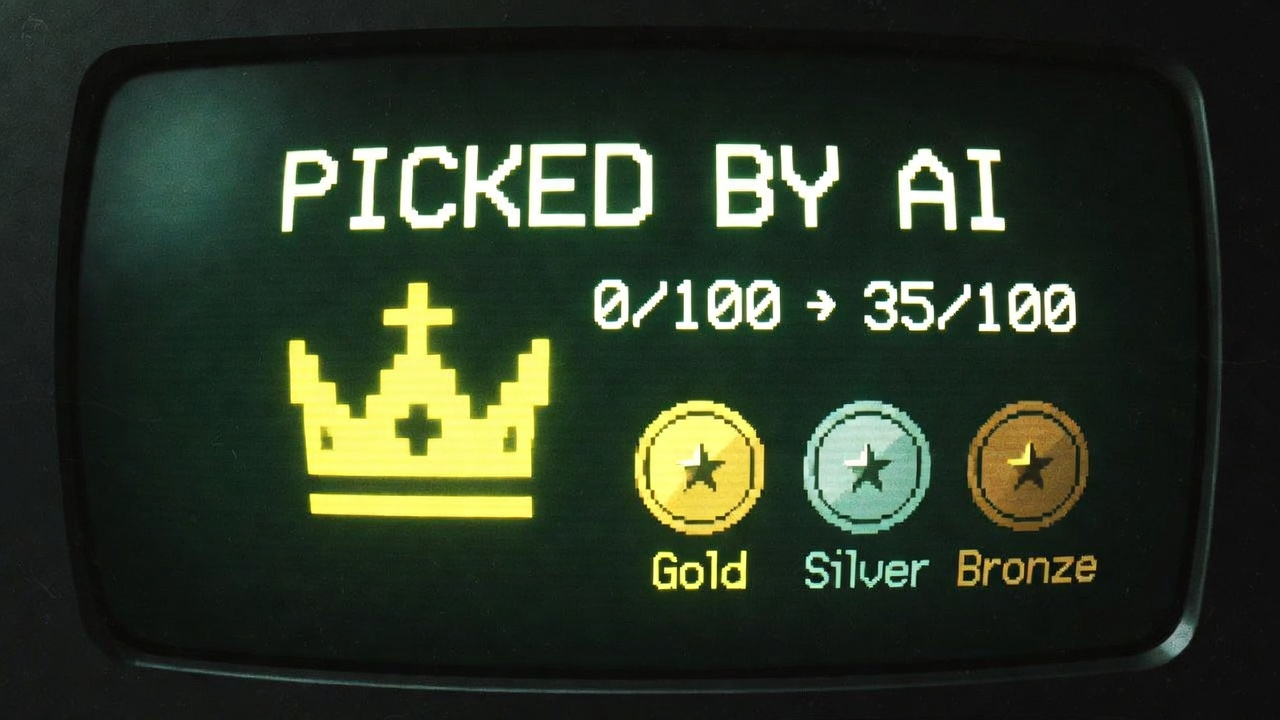
When I realized pickedby.ai itself scored 0 out of 100 on our own tool — yeah, that stung a bit — we started testing what actually moves the needle.
We added an llms.txt file. We posted on Reddit with our actual product name in the title. We wrote one comparison piece. Within 24 hours, our score went from 0 to 35.
Not 100. Not even close. But the direction changed. And we learned something important: you don't need to go viral. You just need consistent, public, named mentions across a handful of the right places.
5 things that actually move your score
- Put your product name in the first sentence of every public description. Gumroad, Etsy, Twitter bio — the first line should contain your exact name and what it does. AI reads the top of pages first.
- Get 2–3 public posts mentioning your product by name. A Reddit thread in your niche. A Medium post. A Twitter thread. Each one is a real data point.
- Find a "best of" list in your category and get on it. These roundup posts are some of the most cited content when AI answers recommendation queries. One mention here is worth ten mentions on your own page.
- Write one comparison piece. "[Your product] vs [Competitor]" or "Best [category] for [specific audience]." It signals to AI what category you belong in — and it targets a real query people are typing.
- Pick one name and use it everywhere. Forever. Every variation is wasted signal.
These aren't tricks. They're what discoverability has always required — just applied to a different audience. The difference is that AI is already being used to find products, and most creators haven't thought about it yet.
Start by knowing where you actually stand
The hardest part is knowing what to fix when you can't see the problem.
We built pickedby.ai for exactly this: enter your product name, and in about 10 seconds you'll see a score from 0 to 100 — and exactly which of the five dimensions you're passing and which you're not. No guessing. No generic advice. Just your actual score, and what to do about it.
It's free. No account. Takes less time than reading this post.
WHAT'S YOUR AI VISIBILITY SCORE?
Find out if ChatGPT, Claude, and Perplexity know your product exists. Free, ~10 seconds, no signup.
CHECK MY SCORE — FREE ▶▶One last thing.
Most creators will read this, nod, and do nothing. The ones who check their score today are already ahead of them.